
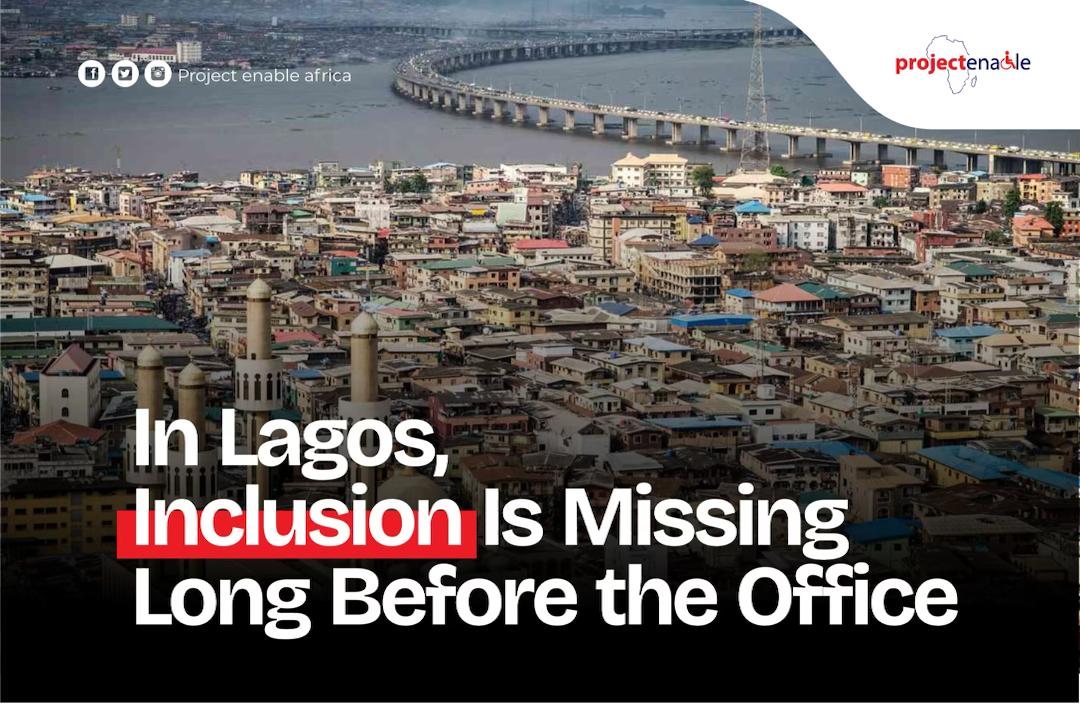
On a Monday morning, in the rain, some of us just try to survive the commute.
It’s 6:47 am. The rain started about twenty minutes ago, and it’s not letting up. The kind of Lagos rain that doesn’t care about your plans, or your wheelchair.
For most working Lagosians, Monday mornings are already a sport. Traffic on the Island, local bus drivers with their own version of traffic laws, BRT queues that stretch past logic. But if you are a person with disability and you’re trying to get to work? The playing field is not even close to level.
“By the time I get to the office, I’ve already used half my energy just getting there. And nobody sees that.”
That’s something I’ve heard, in different words, from too many people. A woman who uses a wheelchair and works on the Mainland. A man with a visual impairment who navigates Ojuelegba every morning. A young professional with cerebral palsy who plans her entire route around roads which flooded last time it rained.
And today? It’s raining. Which means broken pavements become rivers. Kerbs become obstacles. Ride-hailing apps either don’t show up, or the driver takes one look and drives off.
Let’s be honest about what this city offers: almost nothing. The BRT buses have steps. The local buses have steps. The bikes are impossible. Most pedestrian bridges? Don’t even ask. There are no tactile paving strips, no reliable audio signals at crossings, and no ramps that actually lead somewhere useful. The infrastructure was not built with persons with disabilities in mind, and in 2026, we’re still having to say that out loud.
A quick reality check: According to the World Health Organization, over 1 billion people globally live with some form of disability. In Nigeria, estimates suggest this number runs into tens of millions. Many are employed, educated, and fully capable, but the commute alone can become a reason to quit a job, turn down a promotion, or simply not apply in the first place.
That’s the part that rarely gets talked about. It’s not always about whether a company is “inclusive enough” in its hiring. Sometimes it’s about whether a person can physically get to the building. On a dry Tuesday. Never mind a Monday in May when half of Lagos has flooded.
Employers talk a lot about diversity and inclusion these days. That’s good, genuinely. But inclusion has to extend beyond the office floor. It has to ask: how did this person get here? What did it cost them before they even sat down? And what happens on rainy days?
There’s no clean ending to this piece. The roads are still what they are. The buses haven’t changed overnight. But something shifts when we at least stop pretending this isn’t happening, when we name it, talk about it, and start asking who’s responsible for fixing it.
Because a city that makes it this hard to simply get to work is not a city that’s working for everyone.
And that should bother all of us. Rain or shine.