
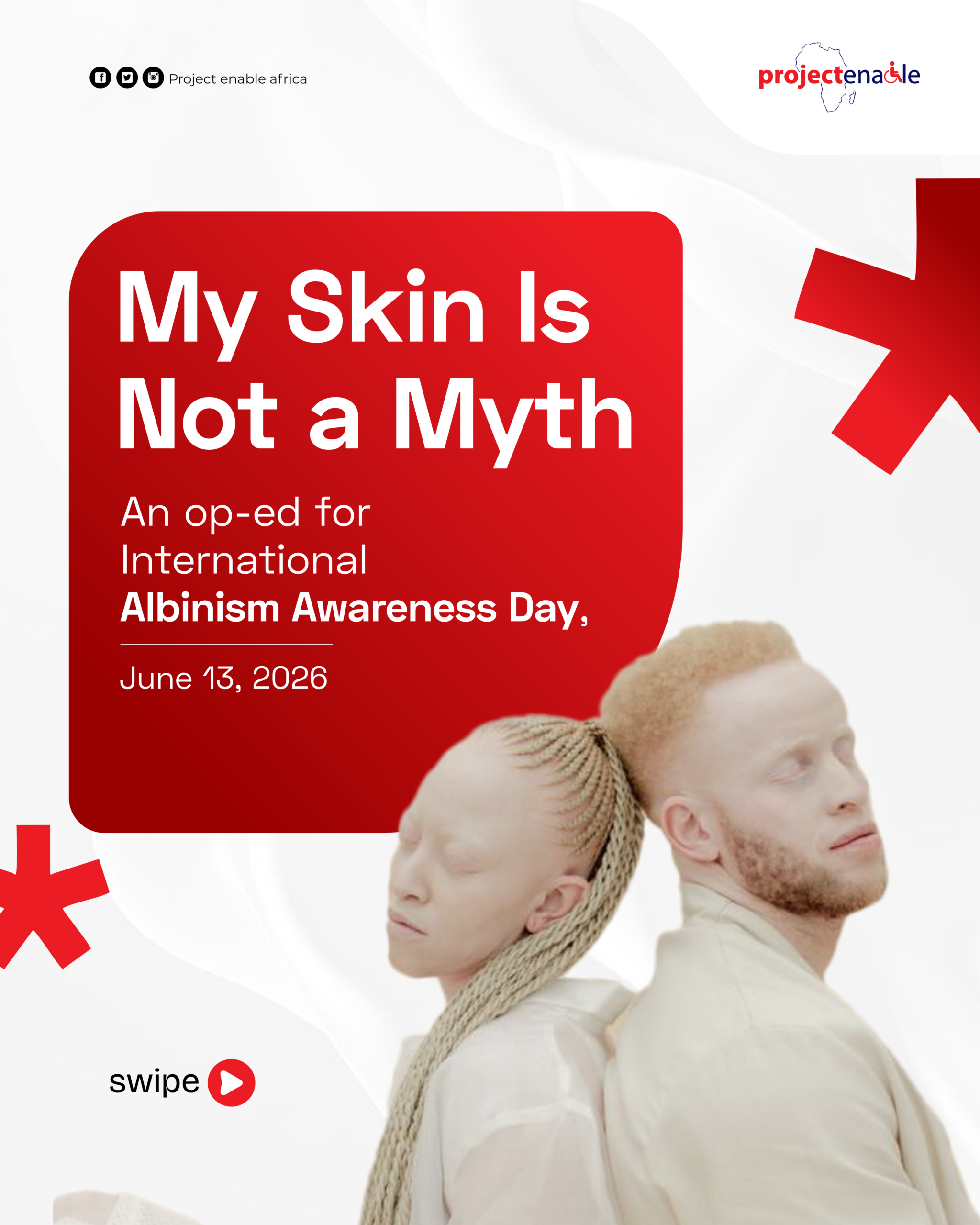
There is a child somewhere in this country who has memorized the sound of laughter that is not meant to be kind. She has learned to walk with her eyes forward because looking sideways means catching a stare she did not ask for. She has heard being called Afin in Yoruba, Bature in Hausa, Onyeochà in Igbo, and Oyinbo pepper in pidgin, words that were once just descriptions but have become, in too many mouths, a full stop on someone’s humanity. She goes to school. She has dreams. She also carries sunscreen that her family can barely afford and a sadness she has not yet found the words for.
She is not a myth. She is a Nigerian child. And today, on International Albinism Awareness Day, she deserves more than a social media post.
Let us be honest with ourselves in a way that we rarely are.
Nigeria is home to one of the largest albinism populations in the world. We live among them. They are in our markets, our offices, our churches and mosques, our families. And yet somehow, in 2026, a person with albinism can still walk into a job interview and be told, not always in words, but always clearly, that their skin is the problem.
This is not a distant African problem. This is Lagos. This is Kano. This is your street.
Across the continent, the violence is extreme and documented. Over 700 attacks and killings across 28 African countries have been recorded since 2006, and campaigners say many more go unreported in rural communities. In June 2024, a two-year-old girl with albinism was abducted and murdered in Tanzania’s Kagera region, her body parts taken to supply a black market built entirely on superstition. She was two years old. Her name should not be a footnote.
In February 2025, the African Court on Human and Peoples’ Rights finally held the Tanzanian government accountable, finding it guilty of violating the rights of persons with albinism to life, dignity, education, and freedom from torture. It was a landmark ruling. It was also, if we are being honest, a verdict that came decades too late for too many.
In Nigeria, the violence tends to be quieter. It does not always use a machete. It uses exclusion. It uses the classmate who refuses to sit next to a child because her mother said albinism is contagious, which it is not. It uses the landlord, who will not rent to someone he considers a bad omen. It uses the church elder who whispers that the parents must have sinned. It uses the HR manager who sees a CV with a photo and finds a reason, any reason, not to call.
Quiet violence is still violence.
Here is what we are not told enough: albinism is simply genetics.
It is a condition, present from birth, caused by reduced melanin, the pigment that gives colour to skin, hair, and eyes. Both parents carry the gene, usually without knowing it. It makes a person more vulnerable to sun damage and to certain visual impairments. It does not make them a spirit. It does not make them lucky or unlucky. It does not make them less.
Ikponwosa “I.K.” Ero, a Nigerian woman born in Ibadan, understood this better than most. She grew up with albinism in a society that had not quite decided what to make of her. She went on to become a lawyer, then the first UN Independent Expert on the rights of persons with albinism, then the architect of the continental policy framework that nations across Africa are now being held to. She did not transcend her albinism. She simply refused to be reduced to it.
She is not exceptional because she has albinism. She is exceptional because she is I.K. Ero.
So what do we do?
We start with language. The word afin is not an insult, but the tone in which it is so often deployed is. Afin is also not an individual’s name, so no one should be addressed as Afin unless it was a name given at birth. We should use people’s names. We can tell our children, early and clearly, that albinism is not a curse, not a punishment, not a supernatural sign of anything at all. We can have that conversation at the dinner table before someone else has the wrong conversation in the schoolyard.
We ask our employers to audit their hiring. We ask our hospitals to stock sunscreen as an essential medical supply, not a luxury item. We ask our government, which signed the African Union’s Plan of Action on Albinism, what exactly it has done to implement it.
And we ask ourselves the harder question: how many times have I looked at a person with albinism and, for just a moment, let a myth live in my mind unchallenged?
The 2026 theme for International Albinism Awareness Day is “Proudly in my skin, celebrating all skin tones.” It is a beautiful phrase. But pride does not grow in soil poisoned by silence. We have to make this country, this continent, safe enough for that pride actually to mean something.
The child I described at the beginning of this piece is real; maybe not as one person, but as thousands. She is navigating a Nigeria that was not designed with her in mind, in a skin that strangers have decided to make a story about.
The least we can do is make sure the story we tell about her, and to her, is true.